2017-02-27

Modelling the holy grey grille

Bringing the Hornby Sierra up to scratch


I haven't written about model vehicles on this blog for some time, so here's the story of a recent project that has kept me busy for a few hours and turned a piece of rubbish that most people wouldn't give a second glance into an accurate scale model. I work exclusively in 1/76 scale, the same as OO gauge model railways, which is well-served for bus and lorry models but not so much for cars until recently, and the subject of this piece may be nostalgic for those who modelled modern-image railways in the 1990s.

The old plastic Ford Sierra made by Hornby was just about all you could get at the time but doesn't seem to have much potential to make a decent model from first impressions and is now all but ignored as it is so inferior to the model cars now available. Don't write it off completely though: with a bit of hard work, as I have proved here, it can be transformed into something that wouldn't look out of place alongside the new generation of diecast cars. The car I have chosen to model is well-known in certain circles and its fascinating story has already been told here, so read on to find out how I replicated it in this small scale... 


A Hornby Sierra that actually looks like a Sierra, and the all-important grey grille is in place

2017-02-18

Unsung heroes: Bedford JJL

Most of the unsung heroes I have featured so far are cars, but the very first one was a bus and today I return to that theme. It's fair to say the Dennis Dart is one of the major success stories of the bus industry, bridging the gap between minibuses and full-size single-deckers and creating a whole new class of vehicle, but a similar bus could have appeared on the market over a decade before the Dart's 1989 launch. This was the Bedford JJL, an innovative rear-engined purpose-built minibus that was first revealed in prototype form back in 1976 but never reached production, and in many ways was a Dart before its time.

Bedford's biggest missed opportunity or the right product at the wrong time?

2017-02-06

Making more of the Maxi

British Leyland's alternative reality


As a fan and owner of the Austin Maxi, I have spent some time thinking about why it didn't achieve the success it deserved. BL didn't really know what to do with the Maxi and basically pushed it to the sidelines, but with a different attitude it could easily have formed the very heart of the range and spawned many more variants. One of the biggest reasons I came up with for its failure was the simultaneous existence of both the Maxi 1750 and the 1800 Landcrab, which seemed to be a pointless duplication that did nothing other than create internal competition, as the latter was basically the same car but with an older engine and without the benefit of the fifth gear or hatchback. This realisation provided the starting point for an entire train of thought that could have changed the course of British Leyland's history for the better!

The Maxi could have been so much more than this dumpy unloved hatchback


Had the Maxi been used as a direct replacement for the Landcrab, the Princess would then become redundant and extending this thought a little opens up the possibility of its place being taken by a whole series of Maxi-based cars using all of the E-series engine variations that existed in reality, from 1500 right up to 2600cc. The existence of these additional Maxis would then cause other models to develop in a more logical way to fit around them, rationalising the range and providing full market coverage that was equivalent to Ford, with the Allegro and Escort, Maxi and Cortina, and SD1 and Granada pairings all being direct competitors. Here's how things might have turned out in this alternative reality... 

2017-01-29

Dream cars: Panther Six

Four wheels good, six wheels better?


How many wheels should a car have? Most of you would agree that four is the right number but there have always been those people who think differently. There was never a more extreme expression of this idea than the absurd six-wheeled Panther Six, the closest thing ever made to a real-life version of Lady Penelope's FAB1 and something that wouldn't look at all out of place in a Gerry Anderson show. Normally I like subtlety and understatement in my favourite cars and don't go for showy types, but I can't help admiring the Panther Six for its sheer audacity: it is unashamedly vulgar and designed purely to attract attention, and is a magnificent monument to 1970s excess so I would find a place for one in my dream garage.


What do you do when four wheels just aren't enough? (Panther press photo via AROnline)

2017-01-27

Public transport, the Equality Act and the Supreme Court

A bad combination?


I have previously discussed my feelings towards the Equality Act as it applies to buses on this blog, and a recent development has reinforced my concerns about the appropriateness of the rules when it comes to achieving proper and justified equality. It relates to the shared bay on modern low-floor buses that can be used both by wheelchair users and those with babies in pushchairs and reached all the way to the Supreme Court. While not making it a legal requirement to give wheelchair users priority use of this bay, the court's guidance strongly implies they have a greater right to it than any other group by indicating that bus drivers must do more to persuade other users to vacate it than simply asking them, for instance by rephrasing their request as a mandatory requirement or refusing to drive on until they have complied.

As long as this remains a shared space that multiple groups have equal entitlement in law to use I can see no possible way to resolve a dispute such as this in a fair manner that doesn't discriminate against either party, so true equality cannot therefore be achieved and the result of this case seems inappropriate and poorly thought out with insufficient clarity and not enough legal substance. While bus operators claim to welcome the new guidance, in reality they have no choice as any public criticism of it would itself cause them to be labelled as prejudiced against the disabled, but as an observer outside the industry I have a number of serious misgivings: it sets a dangerous precedent that implies the disabled are entitled to greater rights than others and is likely to have far-reaching consequences to wider society, not just within the bus industry. 

2017-01-15

Unsung heroes: Jensen FF

Four-wheel-drive isn't just for off-roaders anymore and its use in road cars is now commonplace.
Everybody knows this idea began in 1980 with the Audi Quattro, which was the world's first four-wheel-drive performance car and is hailed as one of the biggest revolutions in automotive history, right? Wrong! That honour actually belongs to something rather less famous that was introduced some fourteen years earlier by a small-scale British manufacturer and is both an unsung hero and a dream car to me.

I'm talking about the Jensen FF, which was not only the first four-wheel-drive production road car but also the first to be fitted with anti-lock brakes and traction control, and introduced all this technology more than fifty years ago. If it was so impressively innovative, why isn't the FF better known and more revered in the annals of history? Read on to find out why this remarkable car just didn't make the impact it deserved and left Audi to lap up the applause over a decade later...

An all-wheel-drive performance car 14 years before the Quattro

2017-01-07

Dream cars: MG ZT 385

One genre of car that fascinates me is the 'sleeper' or 'Q car'. I just love the concept of a subtle and understated performance car that looks for all the world like an ordinary bread-and-butter model and doesn't shout about its power but can give other drivers quite a shock. A great example of such a sleeper is the V8-engined MG ZT 260 and I certainly wouldn't mind owning one of those, but since we're talking ultimate dream cars and don't have to be realistic, I'll go for the full-on but sadly stillborn supercharged ZT 385 to put in my fantasy garage instead.

It looks nothing special but appearances can be deceptive


2017-01-04

New year, new model buses?

It's the beginning of a new year and a good time to look at what may be in store for 1/76 scale model bus collectors such as myself in the near future. Apart from the noble exception of Oxford Diecast, 2016 was a disappointing year for diecasts, with Northcord and Britbus virtually invisible, Corgi suffering financial problems and the near-loss of EFE. I bought no more than two or three new diecast releases during the entire year and the majority of my new additions were resin kits from the growing band of cottage industry producers who have a very different business model but seem far more willing to invest in new products. So far it looks like 2017 won't be much better, with Brexit having had an adverse effect on production costs in China, but I'm still hoping I might be proved wrong and something exciting will unexpectedly appear.

2016-12-30

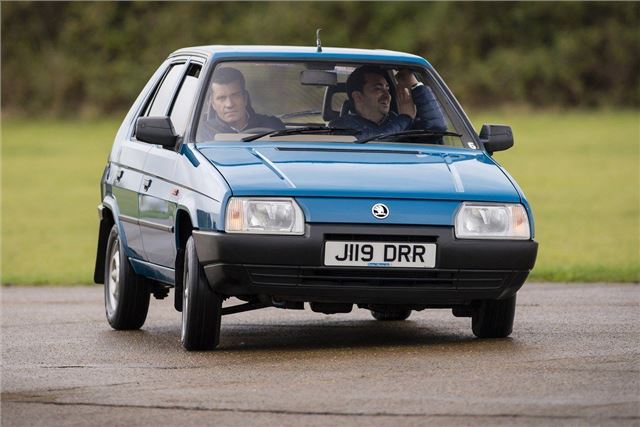
Unsung heroes: Skoda Favorit

Nobody laughs at Skoda nowadays. Thanks to the influence of parent company Volkswagen, the brand has become an award-winning mainstream producer of appealing, well-built and highly-regarded cars, and choosing to buy one is a perfectly sensible decision that won't make you the butt of any jokes. Things weren't always like this though and such a remarkable change has come about in less than thirty years. Although they had a small loyal following in the UK, until the 1990s Skodas were generally considered to be crude bargain-basement transport and objects of derision in popular culture. While Volkswagen must take a lot of the credit for Skoda's transformation, it actually began some years before the takeover with the Favorit, the car that marks the start of the transition from the much-derided rear-engined Skodas of old to today's smart modern range and a worthy choice of unsung hero.

A typical early-90s supermini and not something to joke about
(from http://classics.honestjohn.co.uk/reviews/skoda/favorit/)


2016-12-17

The plague of disintegrating diecasts

There seems to be a growing epidemic in recent years of diecast models simply crumbling to dust for no apparent reason, leaving many collectors perplexed and upset at the loss of a model through no fault of their own. Known variously as 'metal fatigue', 'zinc rot' or 'zinc pest', this is caused by impurities of lead and other metals in the zinc alloy used in diecasting and should be avoidable with modern production methods, but sadly it seems even expensive high-end models are not immune from it and there is no cure once it has taken hold.

Related Posts Plugin for WordPress, Blogger...